The Euro-Mediterranean Free Trade Area (EMFTA) is a free trade zone under construction since the Barcelona Declaration, a framework plan, was adopted in 1995. It started to be built through a series of bilateral FTAs (called Association Agreements) between Brussels and each state bordering the Mediterranean, as well as so-called horizontal FTAs between the non-EU Mediterranean countries themselves, such as the Agadir Agreement.
The countries in question are Algeria, Egypt, Israel, Jordan, Lebanon, Morocco, Palestinian Territories, Syria, Tunisia and Turkey. (Libya is left out of the EMFTA plan as such, but will be served a separate bilateral trade and investment deal from the EU.) All these countries but the Palestinian Territories, Syria and Turkey, signed association aggreements with the EU which all entered into force in the late 1990s and early 2000s.
Many people view the EU’s ambitions to build this special "partnership" with North African and Middle Eastern states — which involves not only trade and investment liberalisation but deep political reform, what Brussels calls "approximation" of other countries’ legal and political institutions with its own — as both imperialist and neocolonial. This is all the more significant taking into account the United States’ plans to weave together a US-Middle East Free Trade Agreement (MEFTA). For the two are in direct competition.
EMFTA was supposed to be completed by 2010. However, a sustainability impact assessment of EMFTA commissioned by the EU already foresees important negative social and environmental consequences. Complicating things further, French President Sarkozy took the initiative to set up a Union for the Mediterranean, involving only the countries that border the sea, which was launched in July 2008. Further still, questions have been arising as to why the EU does not merge its Mediterranean FTA initiative with its GCC FTA initiative.
In September 2011, the EU announced the start of negotiations with Egypt, Jordan, Morocco and Tunisia. But talks on Deep and Comprehensive Free Trade Agreements (DCFTAs) only started with Morocco and Tunisia, as Egypt and Jordan have so far refused to start such negotiations.
In 2010, the EU and Morocco signed a trade agreement on agriculture (which also covers fisheries). Critics have noted that the agreement will promote the exploitation of the disputed territory of Western Sahara, that the main benefactors will be transnational companies and the King of Morocco, and that small farmers will suffer under the deal.
The European Court of Justice ruled that the agriculture agreement and the fisheries deal with Morocco did not apply to Western Sahara in December 2016 and in February 2018, respectively. However the European Parliament disregarded the Court and backed the application of both agreements to the Western Sahara in January 2019 and in February 2019, respectively.
As for DCFTA negotiations, they were halted with Morocco in 2014 but are expected to resume in 2019. In Tunisia, the talks officially began in 2016, and accelerated in 2018 and 2019.
DCFTAs impact all sectors of the economy, including agriculture, through the removal of tariff and non-tariff barriers. They are "WTO+" and "new generation" agreements: they go further than the WTO (on the protection of intellectual property, the opening up of public procurement, competition rules, etc.) and impose regulatory harmonization (in this case, the adoption of the European regulatory system). They also liberalize investment, and include an investor-state dispute resolution mechanism.
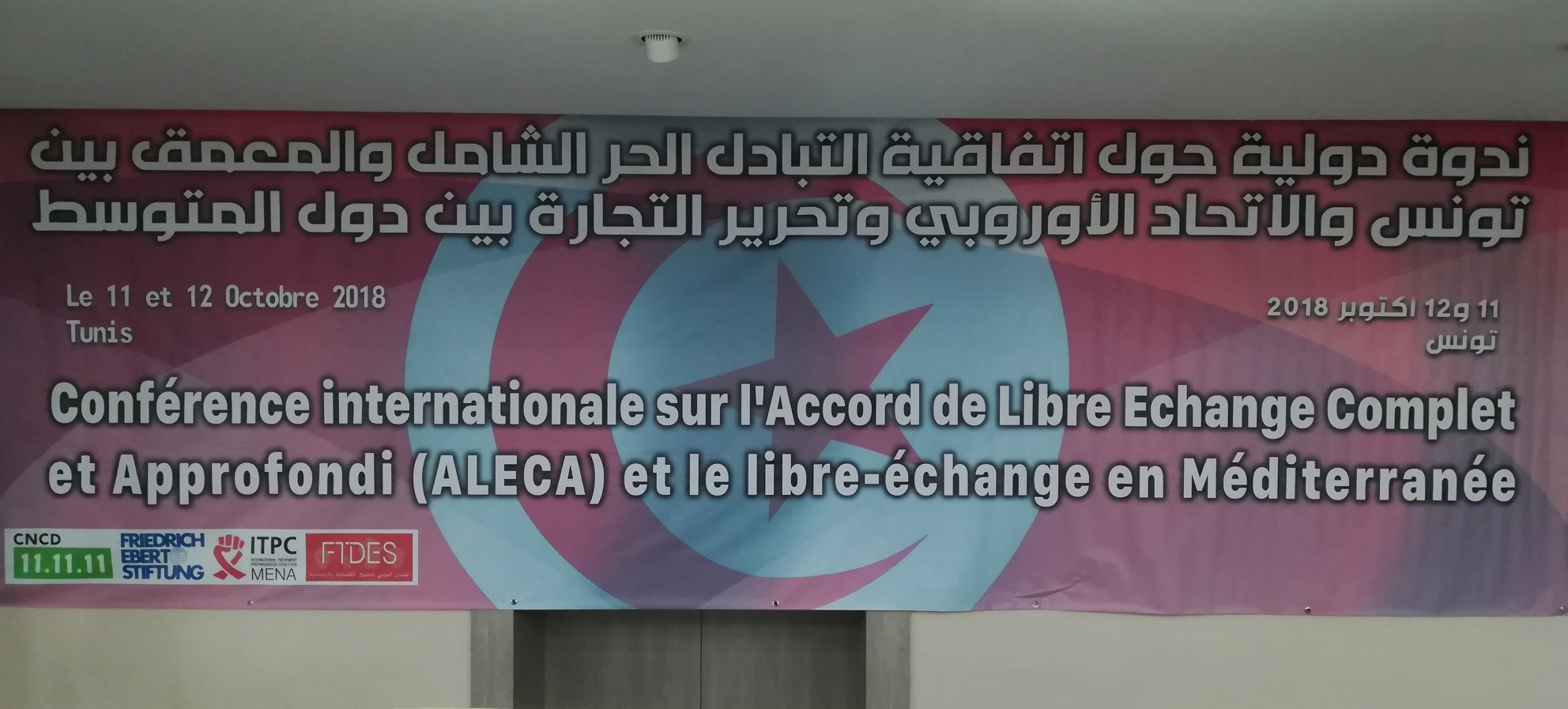
In Morocco and Tunisia, many civil society organizations, trade unions, agricultural and even business organizations have expressed serious concerns about the consequences on the economic situation, on the sovereignty of the state and on economic and social rights. Other voices totally reject such an agreement, seen as imposed by the European side. In Tunisia, mobilizations against the agreement were initiated by farmers in some regions, and other activists in Tunis, notably during the April 2019 negotiating round.
Marco Jonville (FTDES, in Tunis) contributed to this text
Last update: September 2019
photo: bilaterals.org